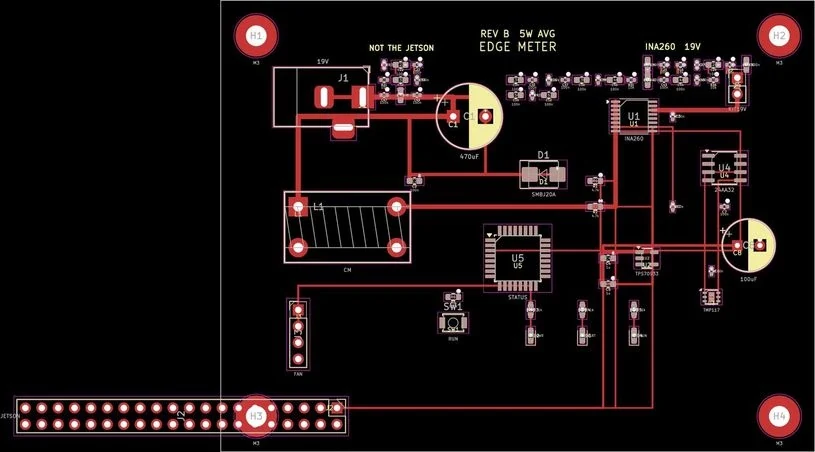
- Transient load steps on the 5 V rail in ngspice-42: 5 W holds, 7 W sags to 3.75 V and fails.
- Current and power read through an INA260 monitor, per its datasheet.
Hardware · KiCad 7 · ngspice-42
Hardware
Three boards for the forward edge of DefenseScope and Cascade: an edge meter carrier, a node carrier and a sensing harness. Designed and simulated, with Gerbers exported.
Status: designed and simulated. Not fabricated. Nothing has been ordered and no board has been measured. Every number here is a datasheet reading, arithmetic or an ngspice trace, and says which.
01 · Tier 2 · forward edge appliance
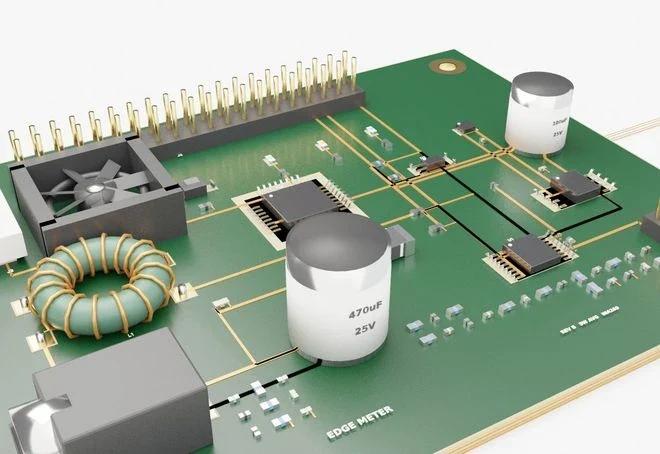
Edge meter carrier
92 × 70 mm · 4 layers · designed in KiCad 7 · simulated in ngspice-42
Meters a bought compute module, so the edge appliance knows what each model costs in watts. The tier runs under a 5 W average model gate: a model that does not fit the budget does not ship to the edge.
02 · Tier 1 · unattended sensor node
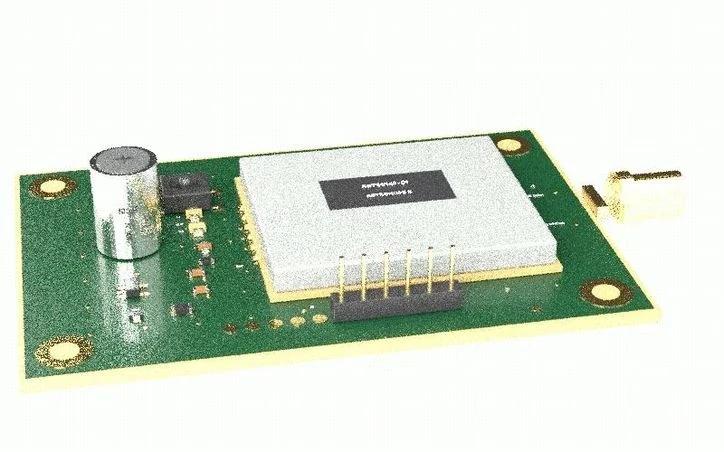
Node carrier
72 × 50 mm · 4 layers · designed in KiCad 7 · simulated in ngspice-42
Carries a satellite IoT module for a node that decides on board and sends 200-byte signed events instead of raw data. The node lives under a 0.25 W average cap.
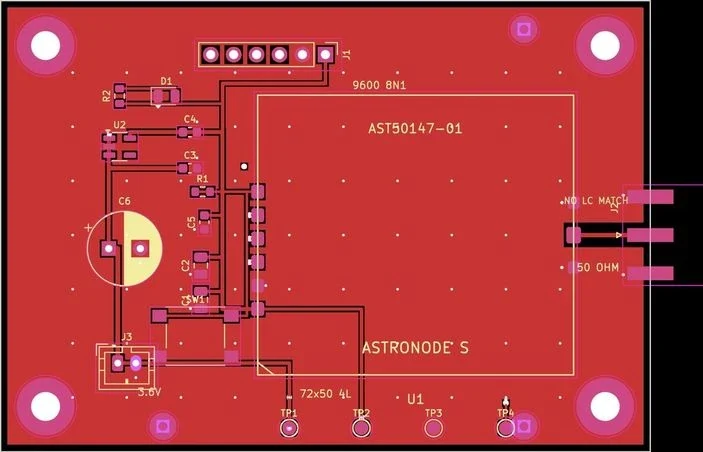
- A 70 mA transmit burst on the 3.3 V rail is 0.231 W and passes the cap.
- 78 mA held is 0.257 W, and the design rejects it.
03 · Tier 2 · sensors for the edge appliance
Sensing harness
140 × 96 mm · 4 layers · designed in KiCad 7 · simulated in ngspice-42
Puts four bought sensors on one board: a passive radio receiver, a short-range radar, a thermal camera and a microphone array. One harness, one power budget, no communications transmitter.
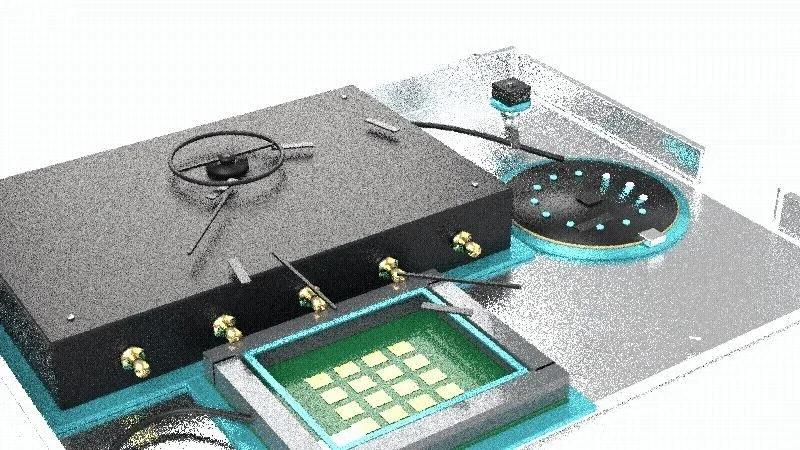
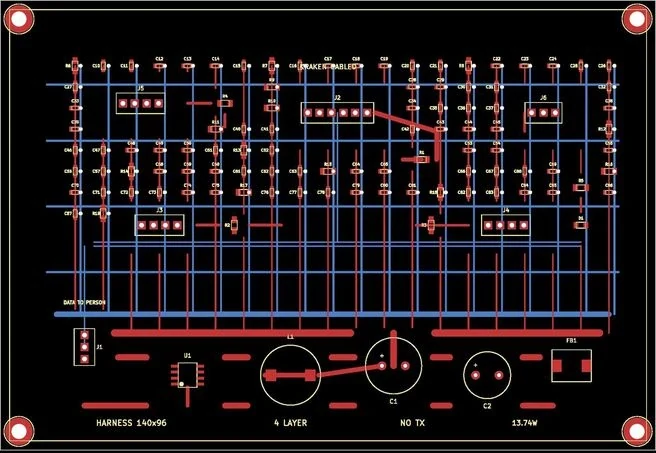
- 13.74 W in total, summed from the four datasheets.
Why the node decides on board.
The difference between 22 days and 866 is software, not a bigger battery.
Where the boards sit.
Five tiers, and the four budgets every tier must meet: power, link, provenance and human authority.
| Tier | Runs | Power | Link | Provenance | Human authority |
|---|---|---|---|---|---|
| 4National sovereign cloud | Command and control, archives, training, simulation | Grid | Fibre to the enclave | Model registry, model cards, signatures | Approves every promotion and release |
| 3Regional fusion node | Multi-source fusion, knowledge graph, console, release gate | Site power | Broadband up; mesh and satellite down | Lineage store, hash-chained audit | The watch: accept, question, reject |
| 2Forward edge applianceEdge meter carrier, sensing harness | On-site inference, local tracks, store and forward | 5 W average model gate | Mesh, LoRa, satellite burst | Signed bundles, measured boot | Lost-link ladder; no effectors |
| 1Sensor node and packNode carrier | Detect on the node, send events, duty-cycled power | 0.25 W average | 200-byte signed events | Hardware identity at source | Sensors inform a person |
| 0Physical world and feeds | Satellites, ship and aircraft reports, gauges, weather | Not ours | Provider interfaces | Source, time, licence, hash at ingest | None |
Renders.
Concept renders made with the designs. None of this hardware has been built.
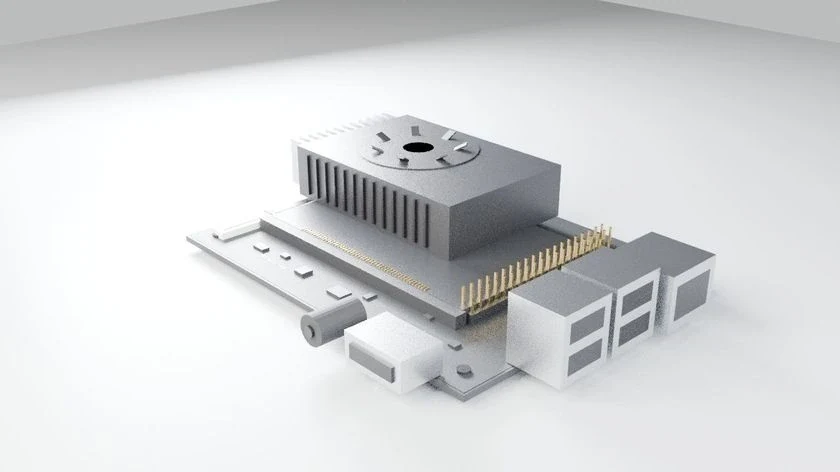
Edge appliance concept, compute under a heat sink. Render, not a photograph.
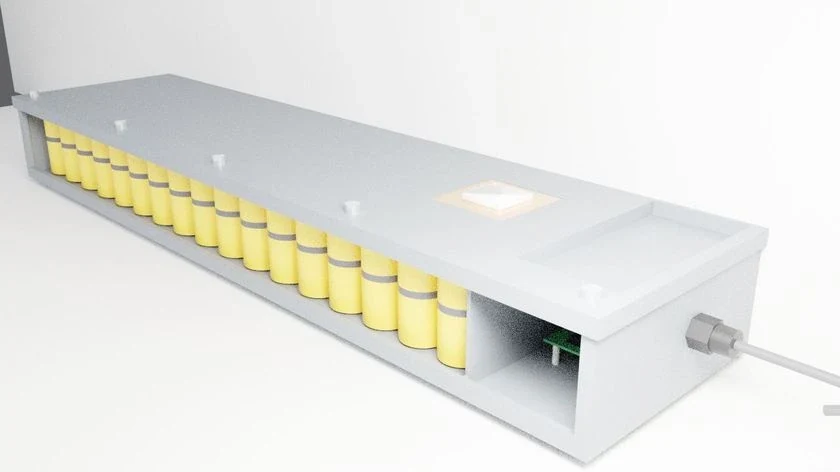
Primary lithium pack concept for a cold-weather node. Render, not a photograph.
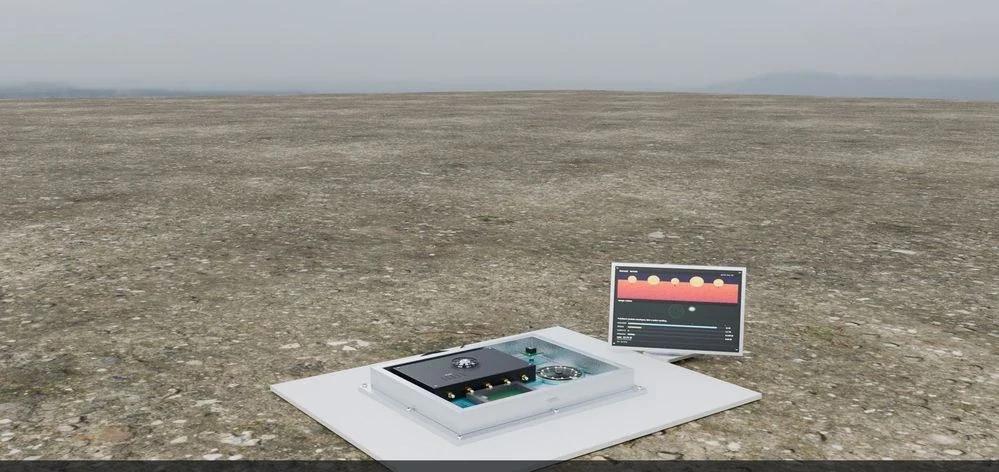
A node on open tundra, as a render. Render, not a photograph.
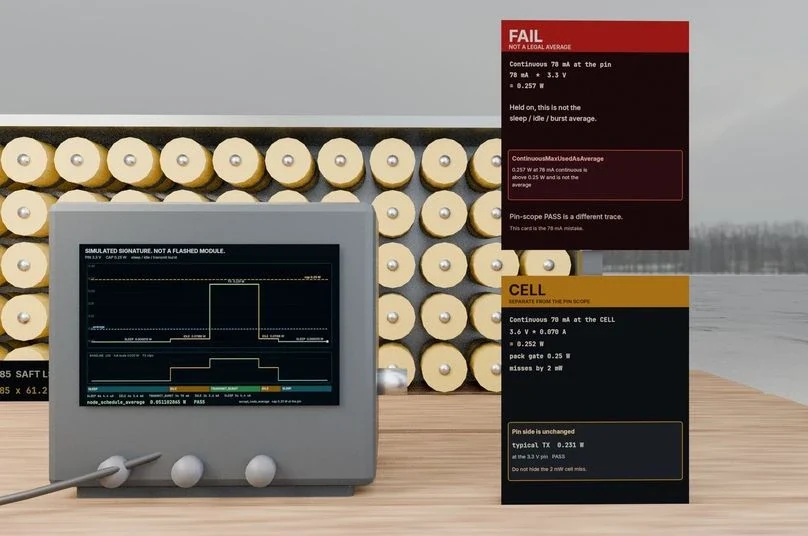
A pack with its simulated pass and fail cases beside it. Render, not a photograph.
Hardware · Next step
Need edge hardware that fits a power budget?
I design to the watt and say which numbers are datasheet, arithmetic or simulation.